
Foreword to the cycle ‘Traces of Desire’
Imagine pausing in a museum in front of a portrait of an unknown man. It was painted several centuries ago. There’s a faint smile on his face, he holds a fig in his hand, and his gaze is directed at someone we can’t see in the picture.
On the small card beside the portrait it says what period it comes from, what technique it was painted in and which school of art it probably belongs to. Perhaps we know the painter’s name. Perhaps we know who the man in the picture was.
But do we know whom he was smiling at?
Was the artist merely a man who’d been commissioned to paint his portrait? Did he know his secrets? Did he desire him? When the workshop door closed, did the rules that held while it was open cease to exist between them?
We shall most likely never find out.
And it’s precisely in that space between what we know and what we can imagine that the cycle ‘Traces of Desire’ was born.
A journey through time
When I began thinking about writing stories set in different historical epochs, I was drawn by the possibility of looking at male intimacy outside the time in which we live. I was interested in how men who desired other men might have met each other, how they talked, seduced one another, hid their relationships or found ways to live them.
But I was also interested in something much simpler. Did they laugh at the same things as us? Were they jealous over a look directed at another man? Did they try to impress someone they liked and land themselves in awkward situations? Did they sometimes want just one shared morning, with no obligations and no need to explain to anyone where they’d spent the night?
Those questions gave rise to thirteen stories, spread across several millennia of human history.
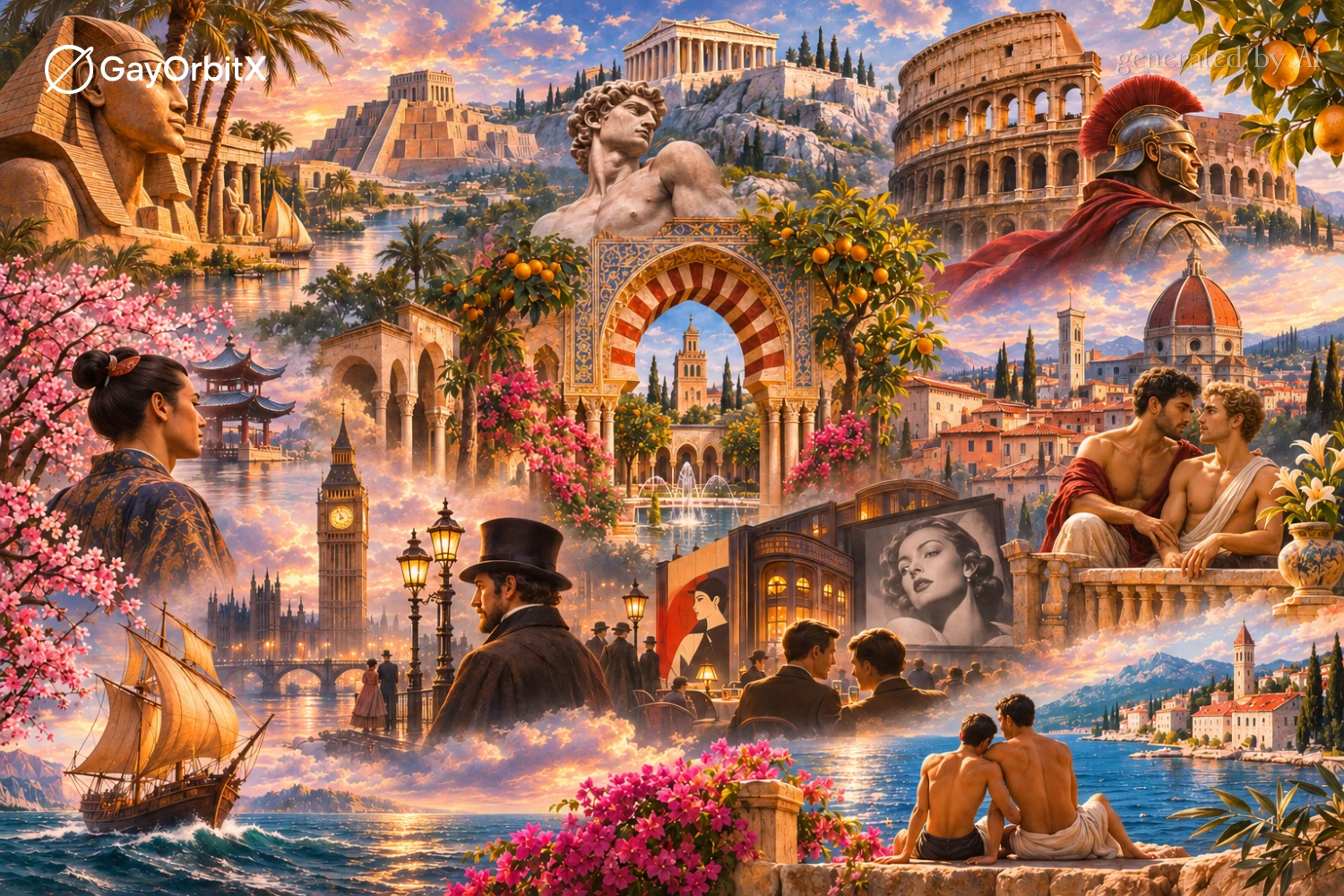
The journey begins in ancient Egypt, continues through Mesopotamia, ancient Greece and the Roman Empire, and takes us to medieval Córdoba, Renaissance Florence and Edo-period Japan. Then we step out onto the eighteenth-century Mediterranean, enter Victorian London, visit Weimar Republic Berlin and postwar Paris, and finally arrive at the Yugoslav Adriatic coast in 1978.
Each of those epochs has its own rhythm, customs, social relations and ideas about what is permitted, acceptable, desirable or shameful.
And in each of them there are people whose desires don’t necessarily fit the rules of the world they live in.
Invented people in real time
‘Traces of Desire’ isn’t a historical study, nor an attempt to reconstruct the intimate lives of real historical figures. All the main characters, their relationships, conversations, love affairs and specific events are products of literary fiction. I didn’t want to invent biographies for people who really existed, but to create new people who could have existed.
The historical setting, however, isn’t arbitrary. Social circumstances, political changes, laws, artistic traditions, crafts and everyday habits rest on historical knowledge. At the end of each story there’s a historical note that lets the reader separate literary fiction from documented fact and, if a particular subject interests them, carry on their own research.
History in these stories isn’t mere scenery. It determines how much room the characters have for their own decisions, what consequences those decisions can have and how they understand themselves and the people they love.
Still, I didn’t want the historical frame to become so dominant that the people themselves were lost behind it. That’s why there are many everyday moments in these stories: conversations at the table, clumsy attempts at seduction, business problems, jokes, rows and those small embarrassments that arise when a man wants to make a better impression than he manages to.
After all, men fell in love even when they had unpaid bills, unfinished jobs and a broken door that needed mending.
A history that didn’t move in a straight line
One of the things that mattered particularly to me while writing this cycle was not to present the history of male same-sex intimacy as a simple journey from persecution to freedom.
Such a journey was never a straight line.
Certain cultures left us works of art, poetry and literary records in which male beauty is openly celebrated. At the same time, social position, age, origin and power relations could determine who was entitled to what kind of intimacy. In other epochs, sexual relations between men were prosecuted, even though those very societies had developed communities, meeting places and people who found ways to live their desires.
The freedom one generation wins isn’t necessarily the freedom the next will inherit. Berlin in the 1920s is one of the most striking examples. And even the abolition of legal bans didn’t automatically mean the disappearance of fear, discrimination and the need to hide.
That’s why the modern notion of a homosexual identity shouldn’t be applied indiscriminately to every earlier epoch either. People in different societies didn’t necessarily understand their sexuality the way we understand it today.
But that doesn’t mean their desire, attraction, longing or love didn’t exist.
Thirteen stories, thirteen different worlds
Although they share a common theme, I didn’t want all the stories to resemble one another.
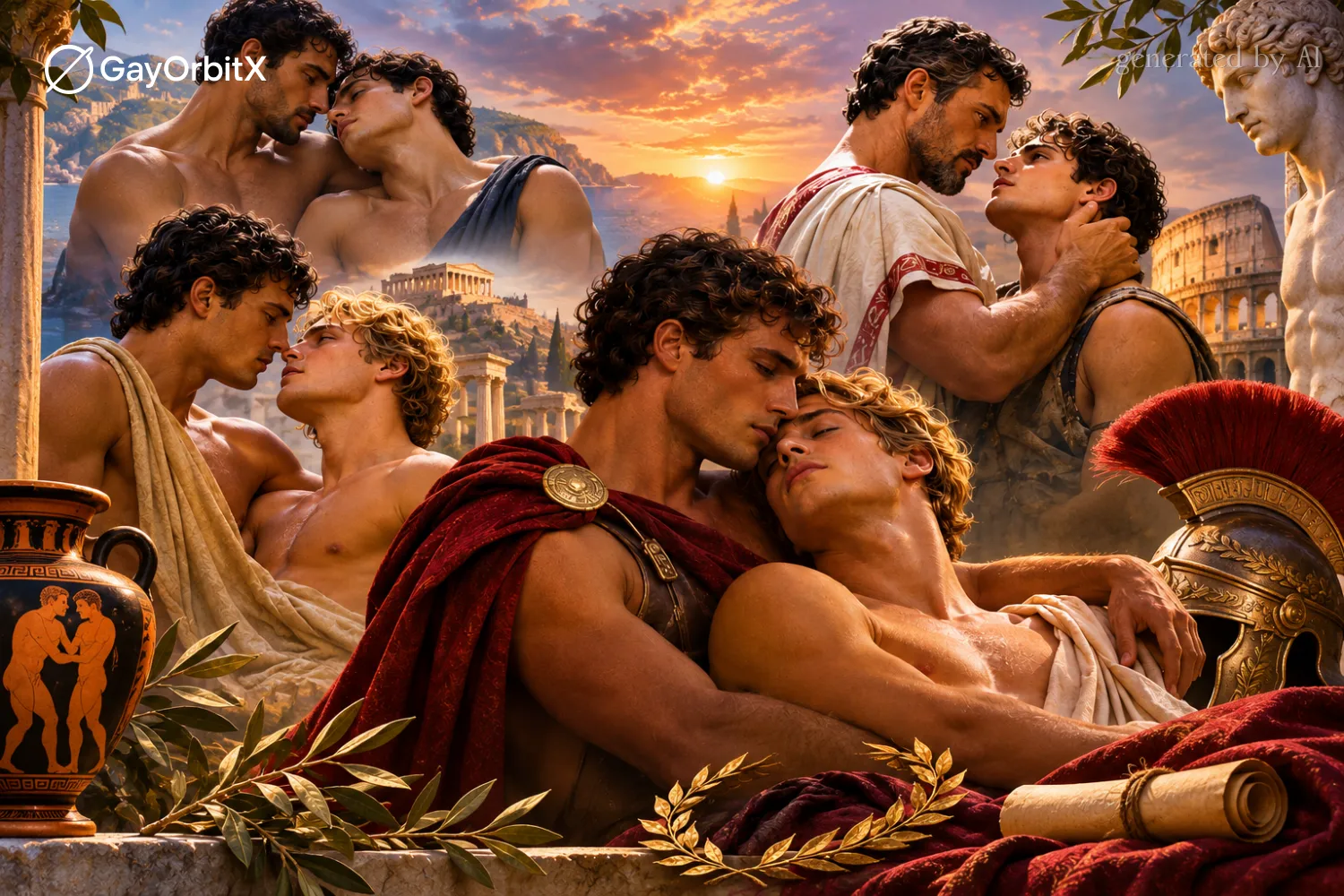
‘The name I did not carve’ takes us into the world of ancient Egypt, where art and the need to preserve someone’s name take on special meaning. ‘A debt of three measures of barley’ is set in the everyday life of ancient Mesopotamia, amid trade, records and human weakness.
In ancient Greece, ‘The man on the other side of the amphora’ raises the question of the boundary between artistic expression and someone else’s intimacy. Two Roman stories, ‘The lover who asked for freedom’ and ‘The man from the warm baths’, explore very different themes: the relationship between love and possession, but also vanity, attraction and the comic consequences of attempted seduction.
In medieval Córdoba a love song becomes the source of unexpected misunderstandings in ‘A song for the wrong man’. In Renaissance Florence, ‘Portrait without a signature’ is about art, secrets and people whose lives a single painting can link.
‘The last performance in a mask’ takes us backstage at a Japanese kabuki theatre, where acting roles, attraction and different ideas of who we are when others are watching intertwine.
In ‘Seven months to land’ two men find closeness during a long sea voyage, while ‘The gentleman who came on Thursdays’ opens the door of a London tailor’s workshop and a world of secret meetings, unknown identities and blackmail.
‘No work tomorrow’ takes us back to Berlin in 1928, a city full of music, nightlife and possibilities we now know were fragile.
In Paris in 1956, ‘The film nobody saw’ explores an artist’s right to portray the love of two men as he sees and experiences it.
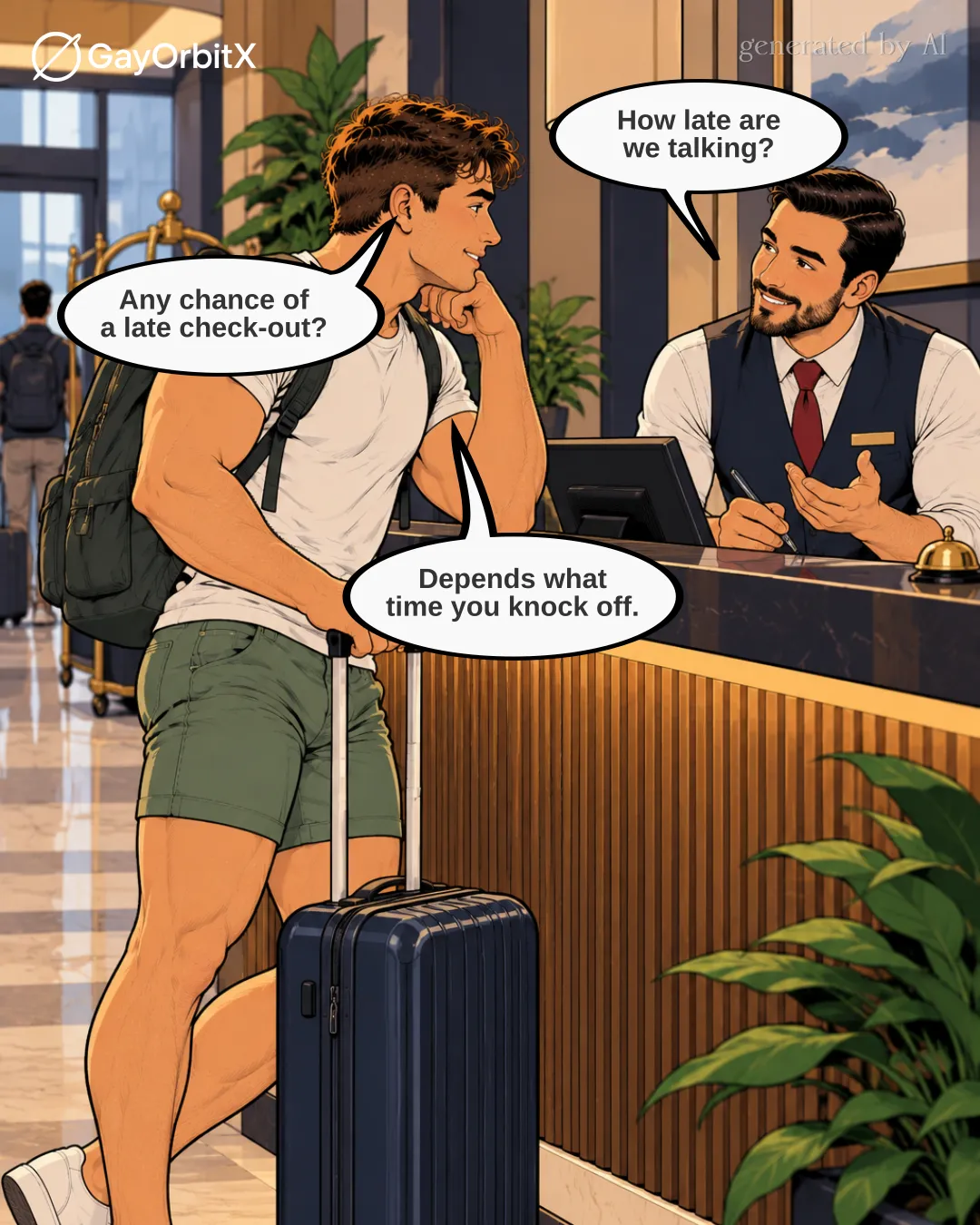
And the last story, ‘A twin room with a sea view’, ends our journey on the Adriatic, where one wrong hotel booking becomes the beginning of something entirely unexpected.
Some of these stories are romantic, some funny, some provocative, and some carry much heavier emotions. In some, eroticism plays an important role, while in others intimacy is revealed through a look, a conversation or a perfectly ordinary gesture.
Not all the stories are about great loves. Not all are about love at all.
Sometimes an encounter between two men is just an encounter that both will remember for a long time.
And that doesn’t diminish its value.
People before history
When we talk about the history of homosexuality today, we often talk about laws, bans, persecutions, great artists, famous figures and people who fought for change.
All of that matters.
But behind that history there were also people whose names never made it into the books. Craftsmen, merchants, sailors, actors, scribes, workers, artists and men who went away on their annual holiday. People who had their jobs, families, faults, ambitions and perfectly ordinary life problems. Their sexuality was part of their lives, but it wasn’t their whole life.
It’s to such people that I wanted to dedicate this cycle. Not idealised heroes who stand for an entire epoch, nor people whose only literary role is to suffer because they love other men.
I wanted them to be interesting, sometimes awkward, witty, insecure, desirable, stubborn and inconsistent. To be able to make mistakes, hurt someone, change their minds or simply not know what they want.
To have the right to be human.
The traces we leave
Each of the thirteen stories is linked to an object. A stone, a clay tablet, an amphora, a manuscript, a portrait, a silk costume, a ship’s logbook, a waistcoat, a photograph, a reel of film or a hotel key.
Those objects aren’t just details belonging to a particular time. They’re small guardians of invented human destinies. An object can outlive the man who made, wore, used or kept it. But its meaning doesn’t have to survive with it.
Perhaps that’s exactly why it’s so interesting to think about all those real objects we look at today in museums, archives, old family albums or on the shelves of antique shops. How many of them once belonged to men who loved other men? How many untold stories did they preserve, and how many did they lose for ever?
I have no answers to those questions.
But literature gives us the chance to ask them. To imagine for a moment a man who wrote a letter, wore a particular waistcoat, sat for a portrait or kept a postcard. To give him a voice, a face, a character and a world he can live in. Not in order to replace history with invention, but to try to feel the life that went on inside it.
Before you are thirteen such stories.
Thirteen encounters with men who lived in different worlds, separated by centuries, languages, beliefs and customs, yet connected by something older than all the rules people have tried to impose on it.
By the desire to look at someone, touch them, want them, get to know them or love them.
Welcome to ‘Traces of Desire’.
Times, customs and rules change. Desire remains.
Thanks for reading!
If this text meant something to you, support GayOrbitX: an independent portal, without censorship and without annoying ads. Your contribution allows us to write more and reach new stories in the field.
Do you love differently? Patreon (mesečna podrška), PayPal, Crypto
Comments
0 komentaraLeave a comment