
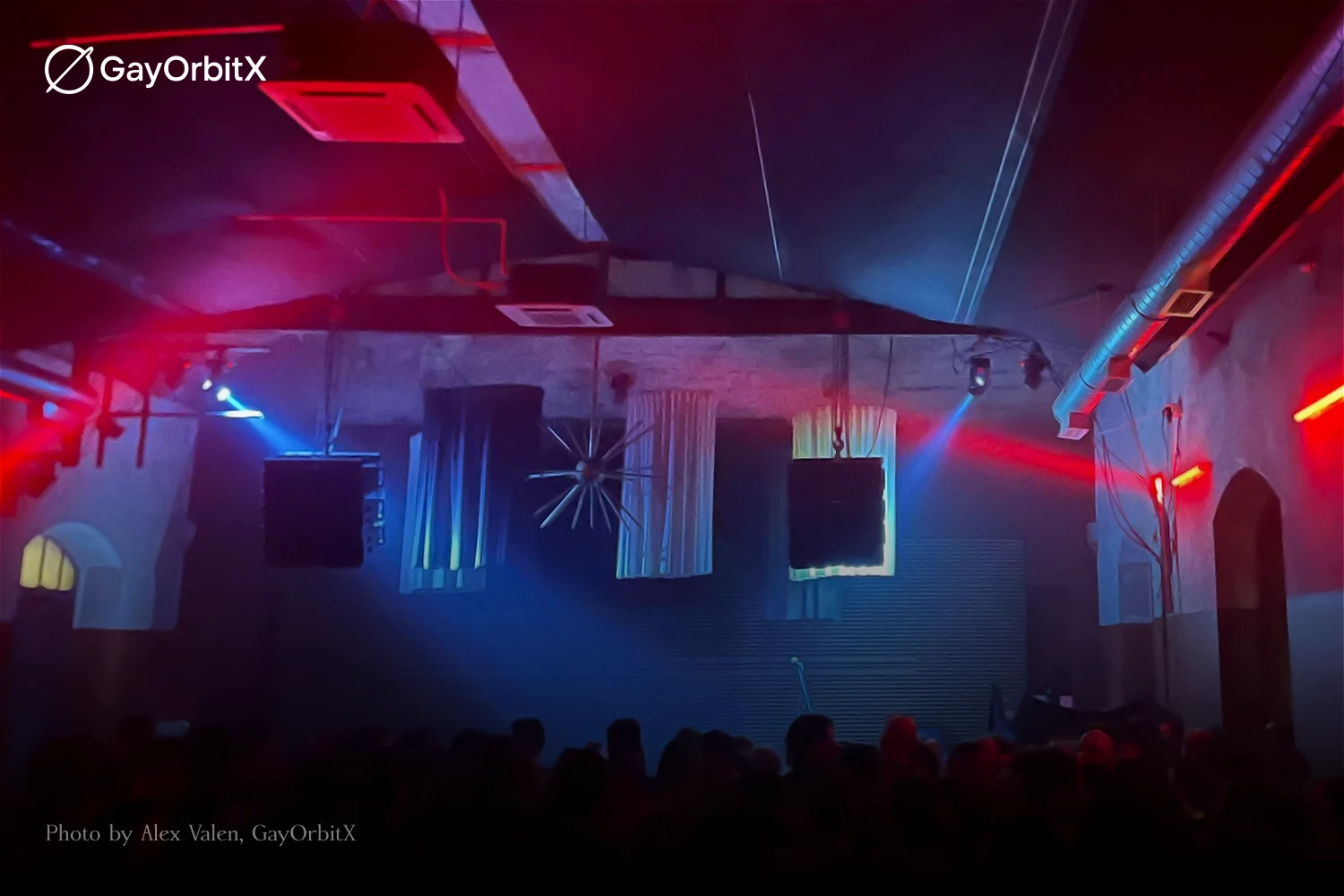
There are concerts where, after an hour, you start wondering how much is left. And there are those where the ending catches you off guard, because you were convinced the night was only half over.
Džipsii’s performance at Belgrade’s Karmakoma on 3 April belonged, for me, to the second kind.
The two hours passed almost unnoticed. I know that sounds like one of those lines routinely written in glowing reviews, but this time I genuinely don’t know how else to describe the experience. The music, the energy, the dancing, the communication with the audience: it all worked well enough that I never felt the need to check the time.
And that doesn’t happen at every concert.
Still, what I took away from Karmakoma wasn’t only an impression of good music. There was something more interesting: the feeling that I’d watched a performer who is still developing his stage expression but already has something that’s hard to learn, the ability to keep you with him.
Music That Doesn’t Ask Permission to Be Different
At Karmakoma, Džipsii presented material from his second album, Jovan, released at the beginning of 2026.
If you try to fit his music into a single genre pigeonhole, you’ll probably struggle a little. There’s pop, electronics, dance rhythms, the R&B legacy of his earlier work and a few other things that don’t slot neatly into the available categories.
I like that.
After all, when I go to a concert, the last thing I want is to spend two hours analysing which genre I’m listening to. What matters much more is that the music moves me, that it doesn’t sound like something I’ve heard a hundred times before and that the performer knows what he wants to convey. Džipsii is quite successful at that.
His music is contemporary, rhythmic, at times very intimate, yet with no urge to court a commercial pop sound at any price. There’s experimentation in it, but not so much that the most important thing gets lost: the pleasure of listening. And I particularly like that you can dance to it. Because, let’s be honest, however much we love artistic concepts, sometimes we just want good music that won’t leave us standing motionless in front of the stage.
Energy You Can’t Fake
If I had to pick just one thing that impressed me most, it would be the energy. Not only his own, but the energy he managed to create between himself and the audience.
Džipsii isn’t a performer who comes on, sings his set and leaves. His show involves movement, dance, gesture and constant communication with the people in front of him. He’s also a dancer, which is clear from the way he uses his body and the space. But it wasn’t only the dancing that impressed me. His presence was far more interesting.
I had the impression that he knew exactly what he wanted to achieve. He seemed self-assured, free, like someone who feels no need to apologise for being the centre of attention. And then, now and then, I noticed something that looked to me like nerves.
Perhaps I’m wrong. Perhaps it’s just part of how he performs. But I found that contrast endearing: a man who seems almost completely sure of himself on stage and then, for a moment, shows he’s only human. It didn’t diminish the quality of the performance for me. Quite the opposite.
Perfectly programmed performers can be impressive, but sometimes a little dull too. With Džipsii I felt that something was really happening before my eyes, rather than that I was watching the precise repetition of a rehearsed routine.
And that’s exactly why I wanted to keep watching.
When the Audience Shouts Not ‘Džipsii’ but ‘Jovane’
One detail stayed with me in particular.
The audience chanted: ‘Jovane! Jovane!’ And not only during the song ‘Jovane’.
At first glance, nothing unusual. Jovan is his real name, and Jovan is the title of the album he was presenting that night. Yet I recognised in it something more than just calling out to a performer.
A stage name often creates a certain distance. It’s part of the identity a performer builds in front of an audience, his stage persona, a kind of shield between the private man and what he shows the world. And then the audience starts calling out his real name.
I’m not claiming that automatically means some special closeness. Not everyone in the crowd knows Jovan just because they listen to Džipsii. But the atmosphere gave the impression that people were interested in the person behind the stage name too. The new album, with its many autobiographical elements, certainly contributes. When a performer brings parts of his own life into the songs, the audience gets a chance to meet something they can’t see through a performance or a photograph alone.
Perhaps that’s why the chanting of his name sounded so natural. As if both Džipsii and Jovan were on stage together that night. And I liked that I never felt one was trying to hide the other.
An Identity That Matters, but Isn’t the Whole Story
I can’t ignore the fact that Džipsii is Roma and an openly queer man.
I’d like us to live in a society where such information doesn’t have to carry special weight. Where an artist can be judged first and foremost by what he creates, with no constant need to explain his origins, sexuality or membership of a particular community.
But we don’t quite live in that society. So I understand how much his visibility can mean, especially to young people who still don’t have enough examples in public life of people they can identify with.
Still, I wouldn’t want Džipsii’s art to stay trapped inside those labels. Being openly queer and Roma in our surroundings may take courage. But courage alone isn’t enough to make a concert good. You need talent. Work. An idea. Stage presence. Something that gives the audience a reason to come back next time. And I think Džipsii already has those reasons.
I didn’t spend two hours at Karmakoma because it’s important to support a queer performer. I spent them because I was enjoying myself.
That distinction matters to me.
Still Room to Grow, but the Foundation Is There
I don’t think I watched a perfect concert.
And perhaps it’s just as well. There’s room for his stage expression to become even more assured, for the production of the show to gain extra breadth and for certain elements to knit together better into a whole.
But I wouldn’t want that remark to be misread. Džipsii isn’t a beginner still trying to work out what he wants to do. He already has two albums behind him, experience of performing in public and an artistic voice distinctive enough that it doesn’t need reinventing. What lies ahead of him, in my view, is the development of everything he already has. Bigger production moves, carefully thought-out concert dramaturgy and continuity could further bring out his potential. Not because something crucial is missing now, but because he has a foundation he can seriously build on.
I’d particularly like him to keep the spontaneity I saw at Karmakoma. It would be a pity if one day he got a perfectly directed show and lost, along the way, what kept me completely absorbed for two hours this time.
An Ending Not Everyone Will Experience the Same Way
The end of the concert was deeply emotional.
I won’t retell exactly what happened. I think different people could experience the same moment in completely different ways, and I don’t want to turn it into proof of anything. Someone might say it was melodramatic. That there was too much emotion. That it could all have ended more simply.
I understand that view too. But it didn’t bother me. Knowing a little about his life path, the circumstances he comes from and the importance of the support he’s had, I experienced that ending as sincere. Perhaps it was too emotional for some people’s taste. Perhaps it was meant to be.
Not every moment on stage has to be measured, elegant and perfectly controlled. Sometimes people simply want to show how much something means to them. And I don’t think they should be faulted for it. After all, if I enjoyed his music for the previous two hours, why would I fault him at the end for showing how much that moment meant to him?
Would I Go Again?
Without much thought – yes.
That is, in the end, perhaps the most honest verdict I can give a concert.
I won’t claim that Džipsii is already a big pop star, nor predict how far he’ll go. The music scene doesn’t work that simply, and talent, sadly, isn’t always enough. But I know what I saw.
I saw a performer with a voice, energy, confidence and the ability to connect with an audience. I saw people who wanted to be part of his show. And I saw someone who can bring his own story to the stage without the music falling into second place.
Most importantly, I spent two hours in which I wasn’t bored. I didn’t wonder when the concert would end. I didn’t wait for one particular song to justify coming. I didn’t feel I was attending an event that matters more for its symbolism than for what actually happens on stage. I simply enjoyed myself.
And when the audience chanted ‘Jovane’, I thought that this might be the loveliest part of the whole story.
Džipsii is the name he’s built for the stage. Jovan is the man standing behind it.
That night at Karmakoma, both had something to show.
And I’d gladly watch both again.
Thanks for reading!
If this text meant something to you, support GayOrbitX: an independent portal, without censorship and without annoying ads. Your contribution allows us to write more and reach new stories in the field.
Do you love differently? Patreon (mesečna podrška), PayPal, Crypto
Comments
0 komentaraLeave a comment